 WGHR Monitoring Tool for Recommendations from the United Nations' Universal Periodic Review for India |
|
|
|
| |
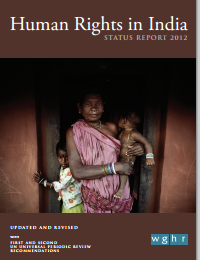
WGHR Recent Events Launch of WGHR “Human Rights in India: Status Report 2012 – Updated and Revised" and Panel Discussion with national human rights institutions, 6 December 2025
On 6 December 2012, the Working Group on Human Rights in India and the UN (WGHR) launched the updated and revised version of its report “Human Rights in India - Status Report 2012”, which was prepared for India’s Second Universal Periodic Review (UPR) at the UN Human Rights Council in May 2012. The updated and revised report presents an overview of critical human rights issues in India, includes recent developments and updates since May 2012, as well as the list of second UPR recommendations accepted by the Government of India in September 2012. The report was released on 6 December 2025 in New Delhi by Justice J. S. Verma. For the full PDF version of the new report click here.
The report launch was inaugurated by a panel discussion with chairs/members of national human rights institutions on the human rights situation in India. The panelists who attended the discussion were:
- Shri Wahajat Habibullah, Chairperson, National Commission for Minorities
- Shri Satyabrata Pal, Member, National Human Rights Commission
- Ms Nirmala Sawant Prabhavalkar, Member, National Commission for Women
- Ms Dipa Dixit, Member, National Commission for Protection of Child Rights
- Dr. Syeda Hameed, Member, Planning Commission
- Shri Theethan, Joint Secretary, National Commission for Scheduled Castes Participants shared their views and analyses of the current human rights situation pertaining to their respective mandates, and also reflected on how to engage with the implementation of the recommendations accepted by India during its second UPR. For the highlights of the panel discussion click here.
WGHR Press Conference: “Human Rights Situation in India Deteriorating; Say New Report and Experts", 7 December 2025 At a press conference to mark the occasion of International Human Rights Day on 10 December, WGHR released the “Human Rights in India: Status Report 2012 - Updated and Revised". WGHR members discussed the human rights situation in India under the three broad themes of the report: 1) Economic, Social and Cultural Rights (ESCR) and Right to Development; 2) Militarisation and Security Laws/Apparatus; and 3) Access to Justice. Speakers at the press conference highlighted key issues of concern under each theme. For the full press release click here. WGHR Members' News and Activities
National Campaign on Dalit Human Rights (NCDHR): National Coalition for Strengthening the [Prevention of Atrocities] POA Act organised the National Dalit Adivasi Sammelan, 23/11/2025
In a vibrant expression of solidarity, thousands of Dalits and Adivasis congregated in the National Dalit Adivasi Sammelan in the capital on 23 November to collectively decry the increasing discrimination and atrocities that Dalits and Adivasis continue to be subjected to in the country. The public event, while drawing crucial civil society attention on the viciousness of social discrimination, also aimed to galvanize strategic political response on the issue by making public a comprehensive charter of proposed amendments to the PoA Act, 1989. read more
Housing and Land Rights Network (HLRN): Shahri Adhikar Manch: Begharon ke Saath (SAM:BKS) - "India’s Human Rights Institutions Not Concerned with Homeless People, Reveal RTI Responses", 8/11/2025
At a press conference organised by SAM:BKS in the capital, human rights activists took to task India’s human rights institutions for their lack of concern and sensitivity towards the persistent and flagrant violations of the human rights of Delhi’s homeless residents. For the full press release click here.
"Custodial Violence: A History of Violence" - Live Mint, 2/11/2025
The Prevention of Torture Bill, 2010, passed by the Lok Sabha is currently waiting for a select committee report on it to be tabled in the Rajya Sabha. Commonwealth Human Rights Initiative (CHRI) and Asian Centre for Human Rights (ACHR) provide a critique for the current Bill and discuss amendments that would bring the Bill in line with the UN Convention against Torture and Other Cruel, Inhuman and Degrading Treatment or Punishment that India has signed in 1975 but has not ratified as yet. Read more
News on Human Rights Issues
“India votes against UN resolution banning death penalty'” – The Times of India, 21/11/2025
ndia was among the 39 countries that voted against a UN General Assembly draft resolution which called for abolishing the death penalty, saying that every nation had the "sovereign right" to determine its own legal system. The resolution that called for a moratorium on executions with a view to abolishing death penalty was adopted with 110 nations voted in favour of it. Read more
“India ranks 131st in press freedom index; Internet 'partly free'” – Chidanand Rajghatta, The Times of India, 21/11/2025
India ranks 131st in the 2012 press freedom index of Reporters without Borders (RWB). Freedom House puts India in the "party free" category in the 2012 Internet freedom rankings. "India's bragging rights about being one of the world's thriving civil societies with strong free speech statutes, is facing searching questions following several episodes aimed at curbing freedom of expression". According to the RWB report, there is an increasing trend in India of web monitoring and censorship by authorities. Read more
“60 lakh more BPL people to be under pension plan” – Prasad Nichenametla, Hindustan Times, 9/11/2025
The Ministry of Rural Development is proposing to cover 60 lakh additional below-poverty-line (BPL) Indians under its pension schemes. The proposals, including enhanced pension payouts, would cost the Central Government an additional Rs 9,500 crore. The recommendations of a committee under the ministry, if accepted, would add to the 260 lakh beneficiaries already covered under the widow, disability and old age pension schemes. The extended coverage would be made possible by altering the criteria under which beneficiaries are currently selected. Read more
“Indian Twins: Growth and Hunger" - T.K. Rajalakshmi, Frontline, Volume 29, - Issue 22, 3 - 16/11/2012
The report "2012 Global Hunger Index" indicates that India, despite the rapid economic growth, has lagged behind in improving its GHI score, proving that growth per se does not translate into more food for all. According to the report, the stagnation occurred when India’s per capita gross national income doubled between 1995-97 and 2008-10, thus a new sustainable socio-economic model that prioritises poor and marginalised people is required. Read more
"Over 30,000 displaced leave relief camps in Assam: Official rehabilitation process stalled as many families lack proper papers" - Sushanta Talukdar, The Hindu, 2/11/2025
More than 30,000 displaced people have left relief camps to return to their homes in the districts of Kokrajhar, Dhubri and Chirang, although the authorities in charge of the rehabilitation process have been at odds with one another. The Bodoland Territorial Council objected to the Assam government’s ‘pro-forma’ list of displaced families that do not possess land documents even as it rejected documents of around 13,000 displaced families Read more
“Many schools have no basic facilities” – Nagesh Prabhu, The Hindu, 2/11/2025
Thousands of crores have been spent under the Sarva Shiksha Abhiyan programme during the last decade. However, over 20% of high schools and 13% of elementary schools in the state of Karnataka lack eight basic amenities whose provision was made mandatory by the Union Ministry of Human Resource Development: boys’ toilets, girls’ toilets, electricity, playground, ramps, library, compound wall and drinking water. Read more
““Mental health legislation must be more therapeutic, humane" - N. N. Raju, The Hindu, 2/11/2025
The Mental Health Act, 1987, although it is more humane than its predecessor (Indian Lunacy Act 1912), it lacked the direction in providing simpler mental health services at the community level. The Mental Health Care Bill 2011 is under consideration for parliamentary approval. The exemption of attempted suicide from prosecution is a significant step forward, however, the Bill takes a retrograde step in legislation of a particular method of treatment. "Any mental health legislation should be more therapeutic than legal and more humane than regulatory". Read more
|